投喂AI Feeding the Machine
我总觉得自己生活在一个折叠的世界里:上班的时候,手边是先进的大模型,客户和同事遍布全球,做增长最快的数据产品研发,有种身处浪潮之中的错觉。一到下班,画风突变——两个不到五岁的小朋友,妈妈妈妈地叫个不停,光是被动回应他们,就已经把我掏空了。妹妹一岁半,夜里要喝两次奶、换两次纸尿裤。自从生老大进产房那天起,睡一个完整的觉对我来说就成了奢侈品。
白天站在技术的最前沿,夜里挣扎在马斯洛需求的最底层。
所以你要是问我对AI怎么看,我总是乐观的。原因特别朴素——这世界上还有太多人,像我这样,需要被解放啊。
如果AI能在夜里帮妹妹冲好奶、轻轻拍着她睡着,能在早上温柔地喊醒赖床的哥哥、帮他刷牙洗脸穿好衣服、送去学校——那我就能拥有一个完整的睡眠,一个清净的早晨。光是想想,就觉得值得为之奋斗。
跟工作中被AI替代的焦虑不同,生活里的这些场景,当事人是盼望甚至渴望被”取代”的。而且每个家庭的需求都不一样——衣服怎么叠、牙刷怎么摆、妈妈做的菜那独一无二的味道…这些细碎的、温热的日常,AI真的能学会吗?
要学会,就需要训练数据。
我甚至想过搭建一个平台,让家庭主妇们在日常劳动中顺手贡献这些数据——她们本来每天都在做这些事,如果还能帮助训练具身智能机器人,顺便多一份收入,何乐不为?
就在这个时候,我遇到了《投喂AI》。
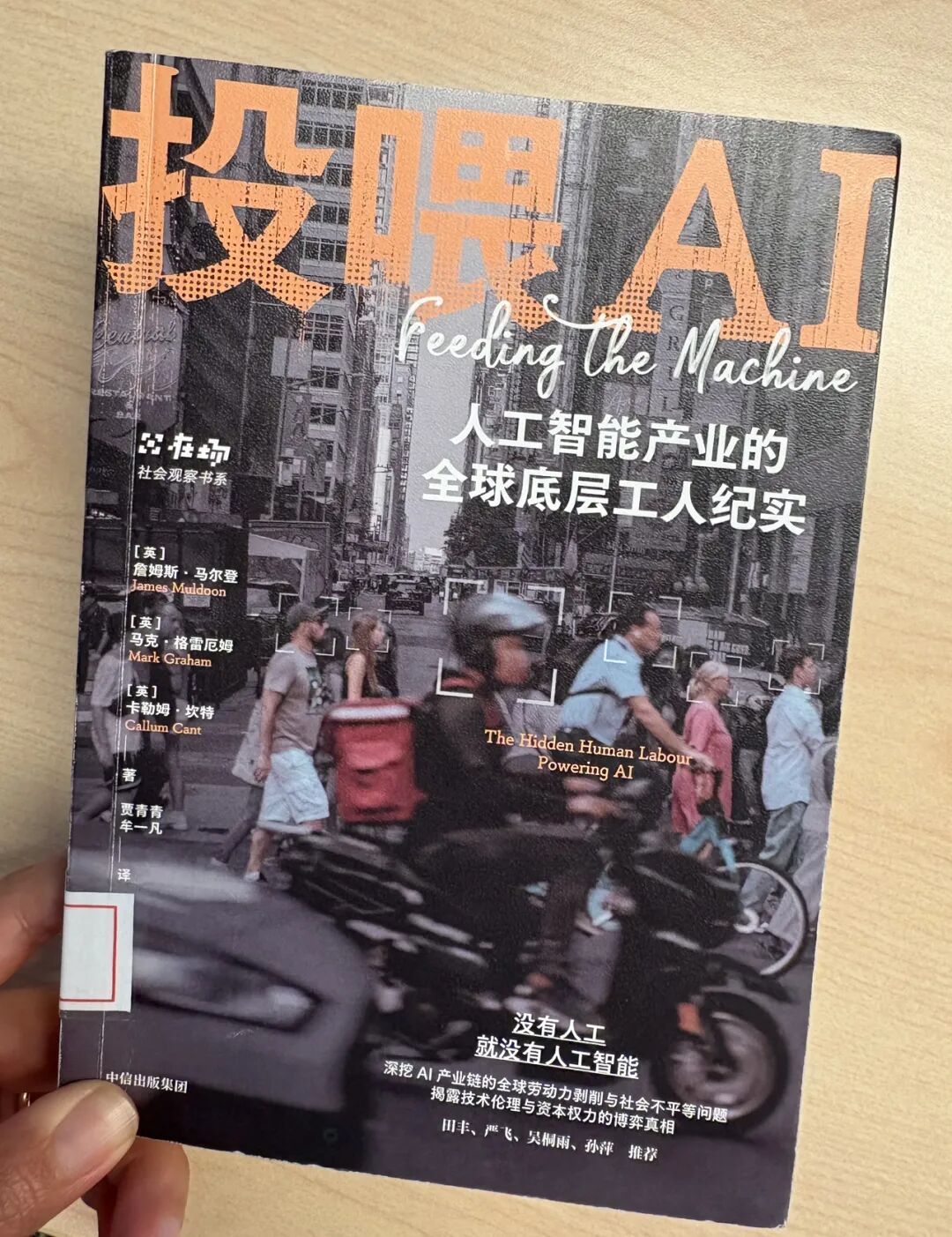
《投喂AI》是一本革命之书,将AI视为一台剥削机器,而人类就是这台机器的原料。从数据标注员、工程师、数据中心技术员、物流仓库员工、到内容创作者,除了投资人之外的所有角色,他们的劳动在某种程度上都只是这台剥削机器的原料。
AI错综复杂的全球生产网络,通过其特有的结构,将劳动者紧密相连,并在竞赛尚未拉开序幕之时,便已预设了胜负之局。AI没有让世界更平等,反而把不平等藏得更深了。
数据标注的工作大量分布在“全球南方”,地域分布和几百年前欧洲殖民主义的版图高度吻合。如果大模型是”大脑”,那光缆就是”动脉”。而当今世界的很多光缆,走的恰恰是当年欧洲人的海上航线。哪里有连接,哪里就有控制的欲望。技术的地理,从来不是中性的,背后藏着欧洲殖民主义、全球资本市场、热战、冷战等错综复杂的政治历史关系。
大模型自身也带着偏见,就像”私立学校培养出来的政治精英,听着挺有道理,仔细一想全是这个阶层对世界的偏见”。说白了,它不是在思考,是在用一种体面的方式复述权力结构。
书中提到的“加州意识形态”,信仰技术能解决一切社会问题——听上去很美,实际上却在平等的旗帜底下,悄悄拉大了精英和普通人之间的距离。理想主义的壳子里头,装的是精英主义。
但这本书不只是在揭露问题,也在探讨解决问题的办法。奴隶制、农奴制,哪一个是自行废除的?当权者从来不会主动让出权力。想要改变,永远要靠人自己站出来。全世界的劳动人民应该联合起来,拆掉AI剥削机器。
阿兰·德波顿说阅读就像把一台收音机带进房间——你本以为房间里安安静静的,结果一开机才发现,各种频率的信号一直都在,只是你以前听不到。
《投喂AI》就是帮我调好了这台收音机。不光能听到AI在做什么,也能听到,它在对谁做什么。
它让我看到了比想象中残酷得多的现实。但奇怪的是,读完之后我并没有绝望。反而心中涌起罗曼·罗兰的英雄主义:AI应该被用来解放真正需要被解放的人。前路仍然漫长,但并非遥不可及。
*投喂AI (Feeding the Machine: The Hidden Human Labour Powering AI)*
*James Muldoon / Mark Graham / Callum Cant*
AI-generated translation.
I often feel I live in a folded world. At work, the latest large language models sit at my fingertips, my customers and colleagues are scattered across the globe, I’m building one of the fastest-growing data products, and there’s that sense of standing right inside the wave. Then I leave work, and the visual style changes hard — two children under five, calling for mama, mama, mama, non-stop. Even just reacting to them is enough to hollow me out. My younger one is a year and a half; she needs two bottle-feeds and two diaper changes through the night. From the day I went into labour with my elder, getting a complete night’s sleep has been a luxury.
By day I stand at the leading edge of technology. By night I struggle at the very base of Maslow’s pyramid.
So if you ask me what I think about AI, I’m always optimistic. The reason is plain: there are still too many people in the world like me, who need to be liberated.
If AI could mix a bottle for my younger one at night and gently pat her back to sleep — if AI could softly wake my elder in the morning, brush his teeth, wash his face, dress him, drop him at school — then I would get a full night’s sleep and a quiet morning. Even just imagining it makes it feel worth fighting for.
Unlike the anxiety of being replaced by AI at work, in the scenes above, the human in question is hoping to be replaced — even longing for it. And every family’s needs are different. How clothes are folded, where toothbrushes go, the one-of-a-kind taste of the food a particular mother makes — can AI really learn these tiny, warm everyday textures?
To learn them, you need training data.
I had even thought about building a platform where homemakers could naturally contribute this kind of data while doing what they were already doing every day, and earn extra income for helping train embodied-intelligence robots. They’re already doing the work — why not?
It was right then that I came across Feeding the Machine.
Feeding the Machine is a book of revolution. It treats AI as a machine of exploitation and human beings as that machine’s raw material. From data labellers to engineers, data-centre technicians, logistics-warehouse workers, content creators — every role except the investors is, in some sense, just feedstock for this exploitation machine.
AI’s tangled global production network, through its specific structure, ties workers tightly together — and, before the race has even properly begun, has already pre-decided who wins. AI hasn’t made the world more equal; it has buried inequality deeper.
Data-labelling work is concentrated in the “Global South,” and its geographical distribution maps almost exactly onto the European colonial map of centuries ago. If large models are the “brain,” fibre-optic cables are the “arteries.” And many of the world’s cables today follow precisely the old European sea routes. Where there is connection, there is the urge to control. The geography of technology has never been neutral; behind it lie tangled political histories of European colonialism, global capital markets, hot wars, cold wars.
The large models themselves carry their biases too — like “a political elite formed in private schools, sounding very reasonable until you realise it’s just that class’s view of the world.” Bluntly: they are not thinking, they are restating the structures of power in a polished register.
The book mentions the “California ideology” — the belief that technology can solve every social problem. It sounds beautiful and in practice, under the banner of equality, quietly widens the gap between elites and ordinary people. The idealist shell is filled with elitism.
But the book is not only diagnosing the problem; it is also exploring how to act. Slavery, serfdom — which of them ever abolished themselves? The powerful never give up power on their own. Change always requires people to stand up. Working people across the world should join together and dismantle this AI machine of exploitation.
Alain de Botton said that reading is like bringing a radio into a room. You had thought the room was quiet, and then you switch the radio on and realise: signals at every frequency have been there the whole time, you just couldn’t hear them before.
Feeding the Machine tuned that radio in for me. I can now hear what AI is doing, and to whom.
It showed me a reality crueller than I had imagined. Strangely, though, I didn’t come out of the book in despair. What rose up instead was Romain Rolland’s heroism: AI should be used to liberate the people who truly need to be liberated. The road ahead is long, but not unreachable.
*Feeding the Machine: The Hidden Human Labour Powering AI*
*James Muldoon / Mark Graham / Callum Cant*